The article in brief
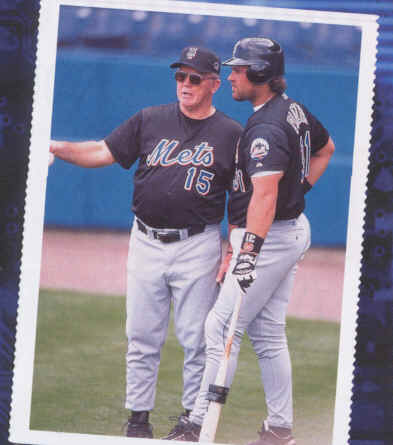
This page summarizes a profile that ran in July 2001 in The Inside Pitch, a newspaper published for Mets fans. Written by Andy Esposito, it described how Jerry Grote had spent part of spring training working with the team’s catchers and how he followed up with Mike Piazza later in the season. A photograph by Marc Levine showed the pair in Port St. Lucie, Florida. This is a retelling, not a reprint, and quotations are limited to short fragments attributed to the people involved.
Class in session
The writer framed the story as a teacher and student reunion. Grote was in New Jersey in May for a card show and took the opportunity to attend a couple of games at Shea Stadium. He wanted to see how Piazza was doing with the changes they had discussed in March. Together with the organization’s top minor league catcher at the time, Jason Phillips, Grote had spent time with Piazza in spring training on his ability to throw out runners trying to steal.
After the game, Grote said he had chatted with Piazza on the field and thought he was doing well. Piazza had already thrown out two runners in a single game at least twice that season, and he was catching more base stealers overall than the year before. Grote’s advice was to keep working on the throwing motion even during casual catch and warm-ups, until the movement became an automatic habit.
Finding the flaw
Piazza had long been known as a strong hitter who called a good game and blocked pitches in the dirt, but critics pointed to his low rate of catching base stealers. Grote said that the problem was a habit that had built up over eight to ten years and could not be erased overnight. The group filmed Piazza and went through the video frame by frame to find where the motion broke down.
What they saw was that Piazza tended to drift to his left as he threw, with his head and body at an angle to his target. On throws to second base against a right-handed batter, he ended up partly behind the hitter, unable to see where the ball was going, and he lost velocity because his momentum was going backward. According to Grote, Piazza picked up the fix quickly once it was demonstrated, and responded with something like “Oh, like this?” and made the correct throw straight away. The article described the old instincts as lingering, which was why repetition mattered so much.
Other catchers
Grote also worked with Todd Pratt and the prospect Vance Wilson. He said Pratt reminded him of himself because he was a hard worker who dug balls out of the dirt, and Wilson was similar. The three catchers were built differently. Piazza and Pratt were both listed at about six feet three, but much of Piazza’s height was in his legs, which made it harder for him to get low. Pratt’s height was in his torso, and Wilson could get lower still. Grote noted that all of them gave their pitchers low targets, though Piazza had to work harder to do it.
The article also noted a tribute from Hall of Fame outfielder Lou Brock, who once called Grote the toughest catcher in the league to run against.
Comparing catchers
To underline his defensive reputation, the article compared Grote with Hall of Famer Johnny Bench. Grote’s career fielding percentage was .991, with 82 errors across 1,421 games, 1,348 of them at catcher. Bench was reported with a .987 percentage, 151 errors and 2,158 games, 1,742 of them behind the plate. The writer said Grote was rated on par with Bench by some observers and better by others.
Background on the career
The profile recapped the path of a San Antonio native then aged fifty-eight. The Mets acquired him from the Astros after the 1965 season in exchange for pitcher Tom Parsons and cash, which the article called one of the club’s best trades. He arrived as the team was putting together its pitching, and he spoke about the 1969 Mets as underdogs whom nobody gave a chance of even sharing a field with the Baltimore Orioles, let alone beating them. He recalled that on August 15 the team trailed by nine and a half games, then made up seventeen and a half and won the division by eight, helped by an 11-game winning streak.
He was also there in 1973, when the Mets took Oakland to a seventh game in the World Series. The Dodgers picked him up in August 1977 for two minor league pitchers for their stretch run, and he played in their 1977 and 1978 World Series. He returned in 1981 with Kansas City and appeared briefly again with the Dodgers.
After baseball
The article said Grote had been outside the game for about twenty years apart from a stint in the Tigers’ system, working in Texas businesses such as cattle and ranch real estate. He stayed close to friends such as Nolan Ryan and welcomed reunions and fantasy camp roles. He said he would like to return as a coach, describing himself as an extension of the pitching coach and manager when he caught.
For more on his career, return to the home page, review the Stat Sheet, or read about the 2001 spring training visit.